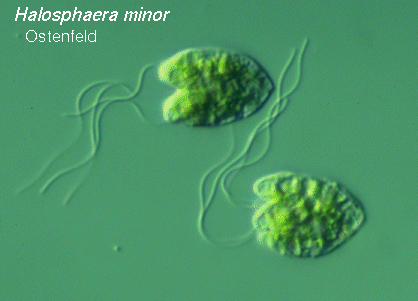
 The flagellate cells are typically 20-30 micrometers long. The diagnostic shape is a four-lobed pyramid. Four flagella emerge from a pit in the center of the pyramid base. A large chloroplast takes up most of the cell volume.
Appearance: Two cell types are typical of Halosphaera species, a small planktonic flagellate and a large planktonic cyst ("phycoma").
The flagellate cells are typically 20-30 micrometers long. The diagnostic shape is a four-lobed pyramid. Four flagella emerge from a pit in the center of the pyramid base. A large chloroplast takes up most of the cell volume.
The cells are covered with up to four layers of submicroscopic scales made of polysaccharides. Nevertheless the cells are fragile and easily disrupted.
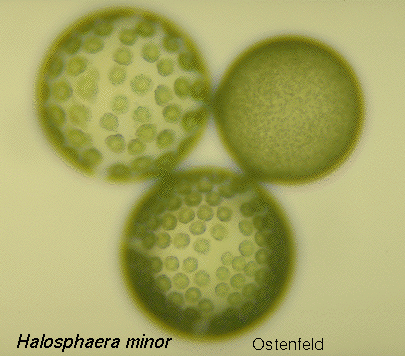 Phycomata may be found in significant numbers at the surface of calm seas in winter. They are spherical and may be a millimeter or more in diameter. They form from a single motile cell, and when mature may yield around 500 motile cells. Unlike the motile cells, the phycomata have a thick cell wall, one layer of which contains sporopollenin. In some species, the phycoma wall is unornamented; in others, fine decorations ("punctae") are present. Fossil phycoma-like structures, termed "leiospheres", have been reported from rocks 1.5 billion years old.
Substructure: The flagellate cell cytoskeleton is based on an asymmetrical array of four flagellar bases and four microtubular roots. One of these roots is expanded into a layer ("spline") of ca. 20 microtubules. At the anterior end of this root, next to the flagellar base from which it emerges, a complex proteinaceous structure ("multilayered structure") is present.
The overall cytoskeleton suggests the symmetrical arrangement present in "chlorophyte" green algae such as Chlamydomonas. However, the "spline-MLS" system suggests the cytoskeleton present in "charophyte" green algae and the land plants.
Also associated with the spline is the aperture of a duct system that extends from the flagellar pit to the posterior end of the cell. It has been suggested that this duct functions to capture food for the cell ("phagotrophy") - making Halosphaera one of the two green plants known that is phagotrophic at the cellular level (the other is the closely related Cymbomonas).
Cultures: none generally available, possibly can be obtained from specialists in England (John Green) and Japan (Isao Inouye). Difficult to isolate and maintain. Never axenic.
Similar genera: Pyramimonas (no phycomata, no MLS); Tetraselmis (cells thecate, flattened not pyramidal, no phycomata, no MLS); Tasmanites (=Pachysphaera), Pterosperma (lentil-shaped flagellate cells, phycomata with ornamented walls)
Selected References:
Boalch GT, Mommaerts JP. 1969. A new punctate species of Halosphaera. Journal of the Marine Biological Association of the United Kingdom 49: 129.
Hori T, Inouye I, Horiguchi T, Boalch GT. 1985. Observations on the motile stage of Halosphaera minor Ostenfeld (Prasinophyceae) with special reference to the cell structure. Botanica Marina 28: 529.
O'Kelly CJ. 1992. Flagellar apparatus architecture and the phylogeny of the "green" algae: chlorophytes, euglenoids, glaucophytes. In: Cytoskeleton of the Algae (D. Menzel, ed.) p. 315. CRC Press, Boca Raton.
Tappan H. 1980. The Paleobiology of Plant Protists. Freeman, San Francisco.